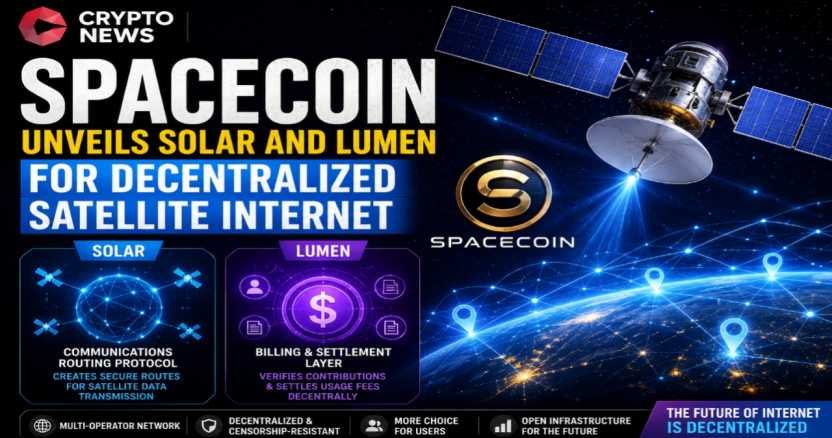
Spacecoin unveils SOLAR and Lumen, a decentralized architecture designed to connect multiple satellite operators and transform internet connectivity.
Spacecoin has introduced two key technologies, SOLAR and Lumen, designed to reshape satellite internet by separating data routing from billing and settlement. The architecture could enable multiple independent operators to share one decentralized satellite network.
Spacecoin is taking a different approach to satellite connectivity with the introduction of SOLAR, a communications routing protocol, and Lumen, a decentralized billing and settlement layer.
The project announced the technical architecture of both systems on September 2, 2026, outlining a model in which multiple independent operators could contribute infrastructure to a shared satellite internet network without depending on a single company to control routing and payments.
The development comes as decentralized infrastructure and blockchain-powered connectivity continue to attract attention across the broader crypto and Web3 industry.
What Are Spacecoin’s SOLAR and Lumen?
Spacecoin’s architecture separates two functions that are traditionally handled by the same network operator: data transmission and financial settlement.
SOLAR Handles Satellite Data Routing
SOLAR is designed to determine and establish routes through which data travels across the satellite network.
Instead of forcing users to rely on one centralized operator, the protocol is intended to allow different network participants to contribute satellite and communications infrastructure.
Users could potentially select available transmission routes while the network tracks the contribution of individual operators.
Lumen Manages Billing and Settlement
Lumen serves as the financial layer of the system.
Its role is to determine how much each participating operator contributed to the network’s data transmission and calculate the corresponding usage fees.
This separation between routing and settlement is central to Spacecoin’s decentralized satellite internet model. Rather than having one company decide both where data travels and who gets paid, the system is designed to distribute those functions across a broader network.
Why Spacecoin’s Decentralized Satellite Internet Model Matters
The global satellite internet industry is currently dominated by large vertically integrated providers.
One of the best-known examples is SpaceX’s Starlink, which operates a large satellite constellation alongside the infrastructure and services needed to provide connectivity to customers.
Spacecoin is pursuing a different model: an open, multi-operator satellite internet network.
Under this approach, different infrastructure providers could potentially participate in the same network rather than building completely isolated systems.
If the model works at scale, it could introduce greater competition among operators and give users additional choices for satellite connectivity.
Could Decentralized Satellite Internet Lower Costs?
One potential advantage of a multi-operator network is increased competition.
When multiple providers can contribute infrastructure and compete for network usage, users could potentially gain access to more service options. Greater competition may also create pressure for providers to improve efficiency and pricing.
However, these benefits are not guaranteed.
Spacecoin still needs to demonstrate that SOLAR and Lumen can operate efficiently under real-world conditions, particularly when managing large numbers of operators, satellite links, users and transactions.
Spacecoin vs. Traditional Satellite Internet
The biggest difference is the architecture behind the network.
Traditional satellite internet services generally operate through a centralized structure in which a single provider controls major elements of the network, including infrastructure, routing and customer billing.
Spacecoin’s approach attempts to break these functions apart.
| Feature | Traditional Model | Spacecoin Model |
|---|---|---|
| Network control | Centralized operator | Multiple operators |
| Data routing | Controlled by provider | SOLAR protocol |
| Fee settlement | Centralized billing | Lumen layer |
| Infrastructure | Primarily provider-owned | Potentially multi-operator |
| User choice | Provider-dependent | Designed for greater route flexibility |
| Network architecture | Vertically integrated | Decentralized |
Could Spacecoin Challenge Starlink’s Model?
Spacecoin is not simply trying to build another traditional satellite internet provider.
Its broader ambition is to establish decentralized satellite infrastructure where independent operators can participate in a common network.
That makes the project conceptually different from Starlink and other vertically integrated satellite internet businesses.
Whether this approach can compete effectively will depend on several factors, including network reliability, satellite coverage, operator participation, regulatory approval, costs and user adoption.
At this stage, Spacecoin’s SOLAR and Lumen announcement should be viewed as an important architectural development rather than evidence that decentralized satellite internet has already reached mass-market scale.
Regulatory Challenges Could Become Important
A multi-operator satellite network could also create new regulatory questions.
Traditional telecommunications regulations are generally designed around identifiable network operators and service providers. A decentralized infrastructure model could make responsibilities more distributed.
Issues surrounding spectrum usage, licensing, data transmission, consumer protection and cross-border telecommunications could therefore become increasingly important as decentralized satellite networks develop.
Spacecoin will need to demonstrate not only that its technology works, but also that the broader network can operate within the regulatory frameworks of the markets it enters.
What Comes Next for Spacecoin?
The unveiling of SOLAR and Lumen represents an early step in Spacecoin’s effort to create decentralized satellite connectivity.
The next major test will be practical implementation.
Spacecoin will need to attract independent operators, establish reliable satellite connectivity, demonstrate efficient routing and settlement, and prove that the system can deliver a competitive experience for users.
If those challenges can be addressed, the architecture could provide a blueprint for decentralized communication infrastructure beyond satellite internet.
The Bigger Web3 Infrastructure Trend
The Spacecoin development also highlights a broader shift in the crypto industry.
While blockchain technology initially became widely associated with digital currencies and decentralized finance, developers are increasingly exploring decentralized physical infrastructure, often referred to as DePIN (Decentralized Physical Infrastructure Networks).
Satellite connectivity could become an important area for this trend because physical infrastructure is expensive to build and maintain.
A model that allows multiple participants to contribute infrastructure and receive compensation based on their network contribution could potentially create new ways to finance and expand connectivity.
FAQs
What is Spacecoin?
Spacecoin is a project focused on developing decentralized satellite internet infrastructure that allows multiple independent operators to participate in a shared network.
What is SOLAR in Spacecoin?
SOLAR is Spacecoin’s communications routing protocol. It is designed to establish data transmission routes and facilitate communication across participating satellite infrastructure.
What is Lumen in Spacecoin?
Lumen is the billing and settlement layer designed to determine operator contributions and distribute corresponding network usage fees.
How is Spacecoin different from Starlink?
Starlink follows a largely vertically integrated model operated by SpaceX. Spacecoin is pursuing a decentralized, multi-operator architecture where different participants can contribute infrastructure to a shared network.
Is Spacecoin part of the DePIN trend?
Spacecoin’s approach fits broadly within the DePIN concept because it aims to coordinate physical infrastructure contributed by multiple independent participants through decentralized technology.
Can Spacecoin replace traditional satellite internet providers?
It is too early to say. The project still needs to prove its technology, attract operators, scale the network and overcome commercial and regulatory challenges before its long-term potential can be evaluated.
Disclaimer: This article is for informational purposes only and does not constitute financial, investment or technology advice. Readers should conduct independent research before making investment or business decisions.